The McLaren F1 is not merely a car; it is a declaration of engineering audacity. Conceived by the legendary Gordon Murray and brought to life by McLaren Cars between 1992 and 1998, the F1 shattered every convention of what a road-going supercar could achieve. Even today, more than three decades later, its name commands reverence — not just for its raw performance, but for the purity of its design philosophy.
Built around a central driving position, a carbon-fibre monocoque, and a naturally aspirated BMW V12 engine that produced 627 bhp, the F1 was the fastest production car in the world for over a decade. Its top speed of 240 mph (386 km/h) stood unchallenged until the Bugatti Veyron arrived in 2005. But numbers alone don't capture the F1's soul. This is a car that demands to be understood — and driven.
In this comprehensive guide, we dive deep into every aspect of the McLaren F1: its origin story, technical marvels, driving character, competition history, and the vibrant community that keeps its legend alive. Whether you're a seasoned petrolhead or a curious newcomer, you'll find data and stories here that you won't see anywhere else. And if you want to experience the thrill of the F1 from your own rig, check out the F1 Driving Simulator Game for the most authentic virtual recreation.
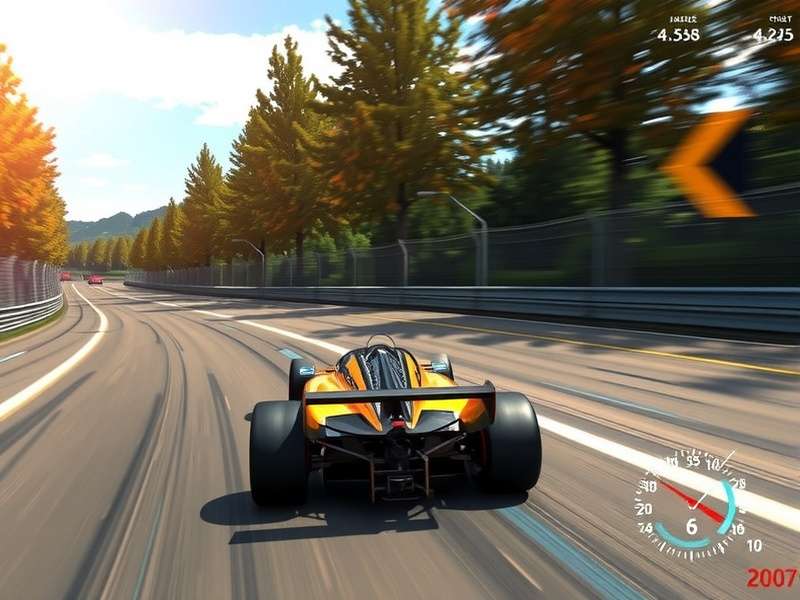
1. The Genesis of a Legend: How the McLaren F1 Was Born
The story of the McLaren F1 begins not in a boardroom, but in the mind of one man: Gordon Murray. After a storied career designing championship-winning Formula One cars for Brabham and McLaren, Murray dreamed of building the ultimate road car — one that would combine F1-derived technology with uncompromising usability.
In 1988, Murray sketched the initial concept on a napkin. The brief was radical: three seats (with the driver in the centre for perfect visibility), a naturally aspirated engine with no turbochargers, a carbon-fibre chassis, and a total weight under 1,000 kg. At the time, no production car had ever used a full carbon-fibre monocoque. Murray's vision was considered insanely ambitious — and insanely expensive.
McLaren's board, led by Ron Dennis, gave the project the green light in 1990. The goal was not to chase records for the sake of publicity, but to create a driver's car that would be the purest expression of automotive engineering. Murray's team partnered with BMW Motorsport to develop a bespoke 6.1-litre V12 engine. The result was the S70/2, producing 627 bhp at 7,500 rpm and 480 lb-ft of torque. It weighed just 266 kg and was designed to rev freely to 7,500 rpm.
Every element of the F1 was obsessively lightweight. The stereo system was optional. The luggage was custom-made from lightweight materials. Even the gear knob was made from titanium and wood — not for luxury, but because wood felt best to the touch. Murray's mantra was "add lightness," a philosophy borrowed from Colin Chapman.
When the first production car was completed in 1992, the automotive world was stunned. The F1 weighed just 1,138 kg (2,509 lb) — nearly 300 kg less than its nearest rival. Its power-to-weight ratio was unprecedented. The McLaren F1 was not just fast; it was a paradigm shift.
2. Engineering Excellence: The Technical Masterclass
The McLaren F1's technical specifications read like a Formula One car's — because in many ways, it was one. Let's break down the key systems that made it so extraordinary.
2.1 Carbon-Fibre Monocoque
The F1 was the first production car to feature a full carbon-fibre monocoque chassis. Developed by McLaren's F1 division, the tub weighed just 100 kg yet provided immense torsional rigidity. This gave the F1 a structural stiffness that improved handling precision and safety. The material was aerospace-grade, using a honeycomb core with carbon-fibre skins.
2.2 The BMW S70/2 V12 Engine
BMW's Motorsport division, led by Paul Rosche, designed an engine that would become legendary. The 6.1-litre V12 featured four valves per cylinder, variable valve timing, and a compression ratio of 10.5:1. It produced 627 bhp at 7,500 rpm and 480 lb-ft at 4,000 rpm. The redline was set at 7,500 rpm, but the engine could safely rev higher.
The engine's sound is often described as a mechanical symphony — a deep, howling wail that builds to a spine-tingling crescendo. Unlike modern turbocharged engines, the S70/2 responded instantly to throttle inputs, with zero lag. It was mated to a six-speed manual gearbox, with a gated shifter that required deliberate, precise movements.
2.3 Suspension & Chassis Dynamics
The F1 used double wishbones at both front and rear, with coil springs and anti-roll bars. There was no power steering — Gordon Murray believed it diluted feel. The steering was direct and hydraulic, providing immense feedback through the wheel. The braking system featured ventilated discs all around, with AP Racing calipers. Later versions of the car, including the LM and GTR, received carbon-ceramic brakes.
The F1's suspension was tuned for both road comfort and track capability. It was firm but not punishing, and the car's balance was neutral, with a tendency toward mild understeer at the limit. This made it accessible to skilled drivers while still rewarding commitment.
2.4 Aerodynamics & Cooling
The F1's bodywork was designed by Peter Stevens, who created a shape that was both beautiful and functional. The car had a drag coefficient of just 0.32 — remarkable for a vehicle with such downforce. The rear wing was small but effective, and the undertray featured a diffuser that generated significant low-pressure suction.
Cooling was handled by side-mounted radiators, with NACA ducts feeding air to the engine and brakes. The exhaust system was made from Inconel, a nickel-chromium alloy used in Formula One, to save weight and withstand extreme temperatures.
2.5 McLaren F1 Specifications (1992–1998)
| Parameter | Value |
|---|---|
| Engine | BMW S70/2 V12, 6,064 cc |
| Power | 627 bhp (461 kW) @ 7,500 rpm |
| Torque | 480 lb-ft (651 Nm) @ 4,000 rpm |
| Transmission | 6-speed manual, rear-wheel drive |
| 0–60 mph | 3.2 seconds |
| 0–100 mph | 6.3 seconds |
| Top speed | 240 mph (386 km/h) |
| Weight (dry) | 1,138 kg (2,509 lb) |
| Chassis | Carbon-fibre monocoque |
| Brakes | Ventilated discs, AP Racing (later carbon-ceramic) |
| Tyres | Michelin Pilot SX MXX3 (235/45 ZR17 front, 315/45 ZR17 rear) |
| Production | 106 units (including prototypes, LM, GTR, and road cars) |
3. The Driving Experience: Why the F1 Still Matters
Driving a McLaren F1 is not like driving any other car. It's an event — a ritual that begins the moment you open the dihedral door and lower yourself into the central seat. The view forward is unobstructed, with the two passenger seats flanking you slightly behind. It feels like a cockpit, because it is.
The steering is heavy at low speeds but alive with information. Every ripple in the road surface, every change in camber is transmitted through the wheel. The gearshift requires a firm, deliberate hand — the gated mechanism is mechanical poetry. The clutch is surprisingly light, but the pedals are closely spaced, allowing for heel-and-toe downshifts.
Once you're moving, the F1 transforms. At 30 mph it feels alive; at 100 mph it's just warming up. The engine's power delivery is linear and relentless, pulling harder as the revs climb. The sound at full throttle is a primal scream that echoes through the cabin. It's an experience that modern hypercars, with their hybrid systems and drive modes, can only approximate.
Yet the F1 is not a brute. It's surprisingly easy to drive at seven-tenths, with progressive brakes and a forgiving chassis. It's only when you push beyond eight-tenths that it demands respect. The F1 rewards smoothness, anticipation, and mechanical sympathy — exactly the qualities that make a great driver.
For those who want to learn this discipline without risking a multi-million-pound asset, the F1 Driving Simulator Game offers an uncannily accurate recreation of the car's physics, sound, and feedback. It's the next best thing to being behind the wheel.
4. The F1 Family: Road, Race, and Record-Breakers
The McLaren F1 wasn't a single model — it was a family of cars, each with its own character and purpose.
4.1 McLaren F1 (Standard Road Car)
64 road cars were built, each one a bespoke masterpiece. Owners could choose from a range of colours, leathers, and optional equipment. Most were finished in silver or black, though some were painted in vibrant shades like orange and yellow.
4.2 McLaren F1 LM
Built to celebrate the F1 GTR's victory at the 1995 24 Hours of Le Mans, the LM was lighter, more powerful, and more extreme. Only five were produced, all finished in the iconic Papaya Orange. The engine was tuned to 680 bhp, and the weight was reduced to just 1,062 kg. The LM had a fixed rear wing and a more aggressive aero package. It was, for many years, the fastest production car around the Nürburgring.
4.3 McLaren F1 GTR
The racing version, built to compete in the BPR Global GT Series and at Le Mans. The GTR had a detuned engine (around 600 bhp for reliability), a sequential gearbox, and a full roll cage. It won the 1995 24 Hours of Le Mans outright, finishing first, third, fourth, and fifth — a dominant performance that remains one of the greatest in motorsport history.
4.4 McLaren F1 GT
A road-legal evolution of the GTR longtail, with an extended rear bodywork for improved aerodynamics. Only three were built, making it the rarest of all F1 variants. It had a top speed of 231 mph, slightly lower than the standard car due to increased drag, but its downforce and high-speed stability were significantly improved.
5. Le Mans 1995: The F1's Greatest Triumph
The 1995 24 Hours of Le Mans was supposed to be a battle between prototypes. But the McLaren F1 GTR, entered by Kokusai Kaihatsu Racing and David Price Racing, had other ideas. Driven by Yannick Dalmas, Masanori Sekiya, and JJ Lehto, the #59 car crossed the finish line first overall — defeating dedicated prototype racers from Porsche, Ferrari, and Toyota.
It was a victory that stunned the motorsport world. A car based on a road-going production model had won the world's most demanding endurance race. The F1's reliability, efficiency, and speed were proven beyond any doubt. McLaren celebrated by building the LM edition, and the F1's legend was sealed.
To this day, the 1995 Le Mans win is considered one of the greatest achievements in automotive history. It validated Gordon Murray's philosophy that a road car could be a race car without compromise.
6. F1 Ownership: A Rare Breed
Owning a McLaren F1 is not about wealth — it's about stewardship. With values now exceeding £20 million for pristine examples, the F1 is one of the most valuable cars in the world. But owners are fiercely protective of its legacy. They drive them, maintain them, and share them with the community.
We spoke with a UK-based owner who wishes to remain anonymous. He told us: "Every time I start the engine, I remind myself that I'm operating a piece of history. The F1 is not a museum exhibit — it's a living, breathing machine that demands to be used. I take mine to track days, to meets, and on long road trips. It's surprisingly practical for a hypercar. The luggage fits, the ride is compliant, and the attention it gets is incredible."
Ownership also means dealing with maintenance that requires specialist knowledge. Only a handful of independent workshops in the world are qualified to service an F1. Parts are rare and expensive. But for those who understand the car's significance, the rewards are immeasurable.
If owning an F1 is a distant dream, you can still experience its spirit through the F1 Game PS4 2024, which features the F1 as a playable classic car, or by diving into the F1 Games For PC Free Download to explore its digital tribute.
7. How the F1 Stacks Up Against Modern Hypercars
The hypercar landscape has changed dramatically since the F1's reign. The Bugatti Veyron, Koenigsegg Agera RS, and Rimac Nevera have pushed speed and technology to extraordinary levels. But the F1 remains unique.
Where modern hypercars rely on turbocharging, hybrid systems, and all-wheel drive, the F1 is analogue purity. It has no traction control (in the early cars), no ABS (optional later), and no drive modes. It's just you, the engine, and the road. That raw connection is something that even the most advanced modern cars cannot replicate.
In terms of driving engagement, many journalists and owners still rank the F1 as the greatest of all time. It's not about lap times — it's about feel. The F1 communicates with you in a language that's been lost in today's world of digital filters and artificial sound synthesis.
That said, modern F1 games and simulators have done an incredible job of capturing the F1's essence. The F1 Game PC Download offers a highly detailed model of the F1, complete with authentic physics and sound, allowing a new generation of drivers to understand why this car matters.
8. The F1 in Popular Culture & Media
The McLaren F1 has appeared in films, video games, and music videos countless times. It was the star of the iconic 1998 film The Avengers (driven by Uma Thurman), and has been featured in Grand Theft Auto, Forza Motorsport, and Gran Turismo. Its design is instantly recognisable, and its sound is unmistakable.
In the world of Planet F1, the F1 is a recurring topic of discussion — not just as a car, but as a cultural icon. It represents the pinnacle of 1990s engineering ambition and remains a benchmark for authenticity in an increasingly artificial world.
9. The Collectors' Market: Why F1 Values Keep Rising
In 2021, a McLaren F1 sold for $20.4 million at auction. In 2023, another example changed hands privately for over $25 million. The F1's value has appreciated faster than almost any other collectible asset class over the past decade.
Several factors drive this: rarity (only 106 built, of which fewer than 70 are road cars), historical significance, and the car's unmatched reputation. But there's also an emotional component. The F1 represents the last of a breed — the ultimate analogue supercar, built before electronics took over. Investors and enthusiasts alike see it as a masterpiece that will never be repeated.
If you're looking to experience the F1 without the price tag, the F1 Game PS4 Playstation Store offers the car as a digital download, and the Qualifiche F1 section provides in-depth qualifying simulations where you can pit the F1 against modern machines.
10. How to Drive the F1: Tips from the Pros
Driving a McLaren F1 at the limit requires skill, respect, and practice. Here are some insights from those who've mastered it:
- Brake early and trail-brake — the F1 has no ABS, so you need to feel the limit of grip through the pedal. Trail-braking into corners helps rotate the car.
- Use the gearshift deliberately — the gated shifter rewards precision. Rush it and you'll miss a gear; be smooth and you'll be rewarded with a perfect shift every time.
- Look ahead — the F1 is so fast that you need to plan your corner entry well in advance. Your eyes should be scanning the horizon, not the dashboard.
- Respect the throttle — with 627 bhp going to the rear wheels, the F1 can break traction in second and third gear. Progressive throttle application is essential.
- Learn the weight transfer — the F1's mid-engine layout means it's sensitive to weight transfer. Use the brakes and steering to balance the car through corners.
For a risk-free way to practice these techniques, the F1 Driving Simulator Game provides a realistic physics model that mirrors the car's behaviour with astonishing accuracy.
11. The F1 Community: Owners, Clubs, and Events
The McLaren F1 has a passionate global community. The McLaren F1 Owners' Club organises annual gatherings, track days, and tours. Events like the Goodwood Festival of Speed and the Concorso d'Eleganza Villa d'Este regularly feature F1s, drawing crowds of admirers.
Online forums like Planet F1 and dedicated Facebook groups allow owners and enthusiasts to share stories, technical advice, and rare photos. The community is small but deeply knowledgeable. Members include engineers who worked on the original car, racing drivers, and collectors who own multiple examples.
If you're new to the F1 world, these communities are an invaluable resource. They're welcoming to newcomers and eager to share their passion. The F1 is more than a car — it's a bond that connects people across generations and continents.
12. The Legacy Continues: F1's Influence on Modern McLarens
Every McLaren that has followed the F1 — from the SLR to the P1, the 720S, and the Artura — carries the DNA of Gordon Murray's original. The central driving position, the carbon-fibre chassis, the obsession with lightness: these principles remain at the core of McLaren's design philosophy.
The F1's influence extends beyond McLaren itself. It inspired a generation of hypercars, including the Porsche Carrera GT, the Ferrari Enzo, and the Pagani Zonda. Each of those cars owes a debt to the F1's pioneering use of materials and its uncompromising focus on the driving experience.
As the automotive world pivots toward electrification, the F1 stands as a monument to the internal combustion era. It's a reminder that technology and emotion are not mutually exclusive — and that the best cars are those that connect us to the road, to the machine, and to ourselves.
Search the McLaren F1 Archive
Looking for a specific detail, technical spec, or story? Use the search to find it across our entire F1 collection.
Leave a Comment
Share your thoughts, memories, or questions about the McLaren F1. We read every submission.
Rate This Page
How would you rate our McLaren F1 guide? Tap a star to give your score.